












































































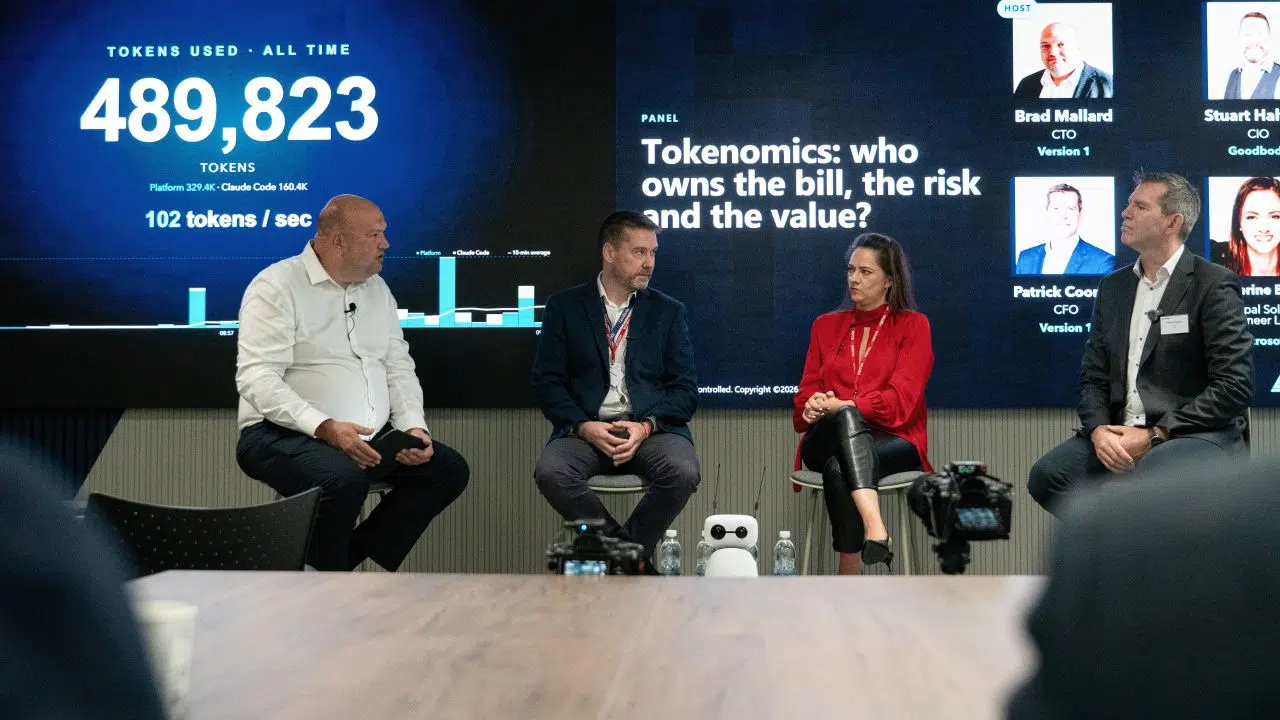
At our Tokenomics event in Dublin, we assembled a panel of technology and finance leaders from Version 1, Microsoft, AWS and Goodbody. They sat down with a room of private sector and financial services leaders to work through a number of questions most organisations haven’t answered yet: who actually owns AI spend, who owns the risk, and who’s supposed to demonstrate its worth. Here are the five considerations that arose from that discussion worth carrying into your own organisation.
1. Who should own AI spend?
Split it three ways: IT and procurement own the platforms, contracts and guardrails, finance owns the forecast and the return on investment, and the business units, wherever the work and the customer valueis generated, own the outcome. Cloud cost sits with IT alone because IT can control it end to end.
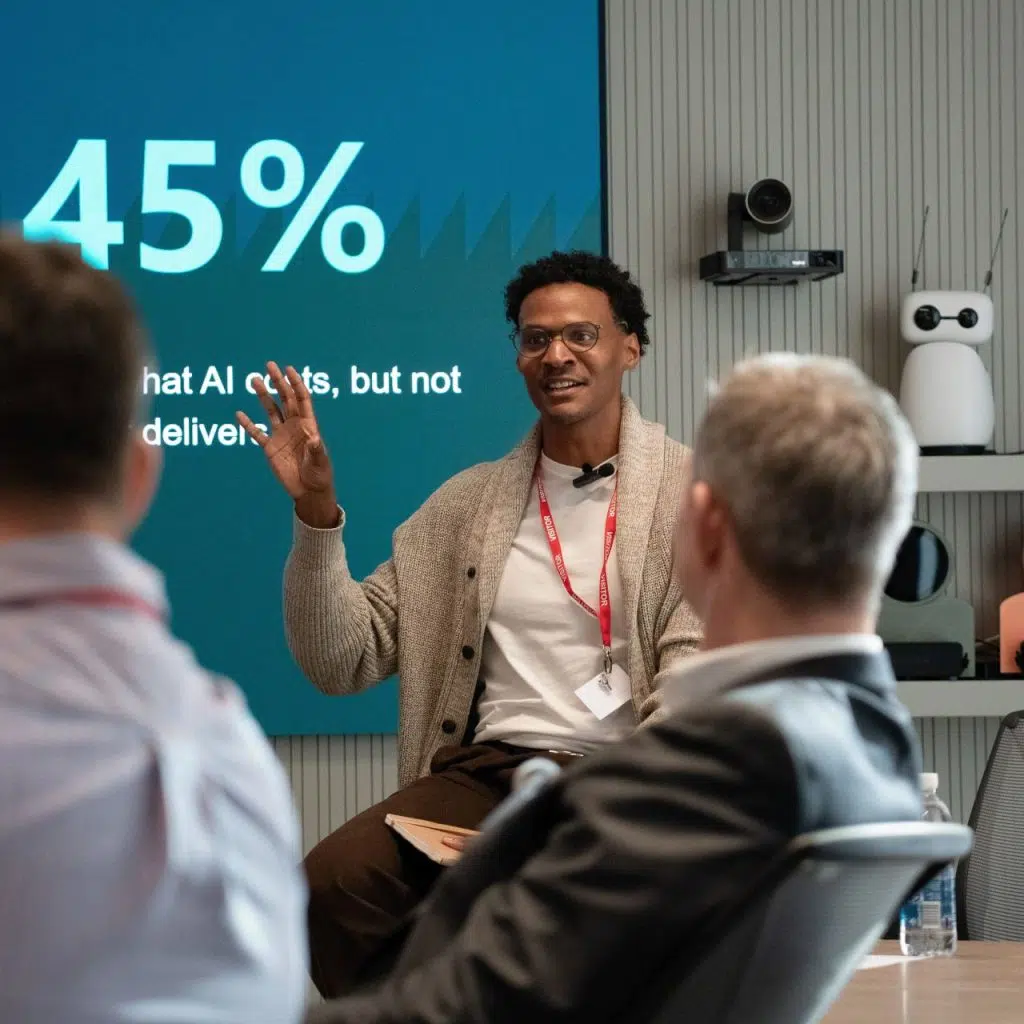
That’s a different shape to a cloud bill, and one panellist described it as the digital cost of labour: a cost that behaves like headcount, not infrastructure.
The practical implication is that AI spend doesn’t belong on an IT budget line once it’s material; it belongs wherever the decision to use it, and the benefit of using it, actually sits.
2. How do you manage AI risk under the EU AI Act?
Set the risk appetite at board level first, then let it cascade down to wherever day-to-day AI decisions are routinely made, rather than leaving individual teams to set their own tolerance by default. One panel member described building their AI governance ahead of the EU AI Act taking effect, not after. The approach was deliberately boring: guardrails and a risk framework first, board agreement on appetite second, distribution third.
Previous technology shifts, cloud, blockchain, mobile, mostly had to be sold upward by IT. AI arrived with the board already paying attention, which changes who needs convincing and who needs equipping.
The risk of inaction came up as often as the risk of moving too fast. One story from the room: a construction firm initially refused to let any AI near their tender process, worried about data leakage, until it became clear staff were already pasting commercially sensitive tender numbers into public tools without anyone’s knowledge.
The fix wasn’t banning AI, it was bringing it inside a controlled environment with inherited data controls, because the alternative wasn’t “no AI use”, it was ungoverned AI use nobody could see.
3. How do you measure AI value before you have perfect data?
Start with adoption, not ROI: measure whether people are using AI safely and getting comfortable with it before trying to measure what it’s worth. The most useful account of proving value came from an organisation that deliberately didn’t try to measure everything from day one. It was only after that foundation was in place did the measure shift to business value and, even then, the first version was intentionally rough.
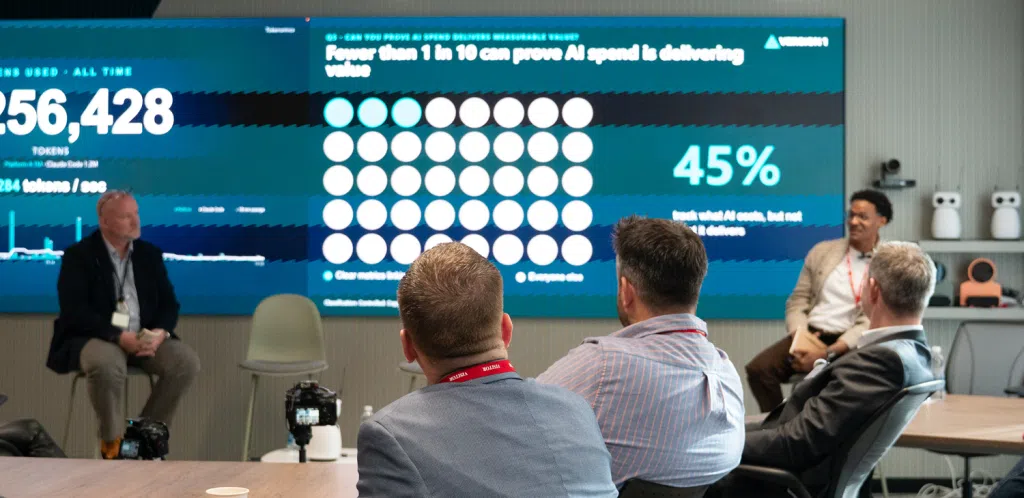
One caution from the same conversation worth remembering: whatever you choose to measure becomes the target, and it will start driving behaviour, for better or worse.
A metric selected too early, or too literally, around something easy to circumvent (prompts sent, logins, hours claimed) will get gamed. The organisations getting real value were the ones that moved from measuring activity to measuring outcomes once the basic adoption question was answered.
4. Can you negotiate enterprise AI pricing?
Not with a lot of latitude yet. Even multi-million pound commitments to the major model providers currently return only a 2 to 3% discount, and some vendors have moved pricing on certain consumption models by 13 to 17 times within the past year. The economics for the model providers themselves don’t yet add up, which points toward prices moving in one direction for now, not the other. None of that is within an individual organisation’s control.
One panellist described this as FinOps on steroids, harder than cloud cost management by an order of magnitude, but also the single biggest lever available. Deliberate model selection and architecture (choosing the cheapest model that can do the job rather than defaulting to the most capable one) was reported to cut token costs by more than 90% compared with calling the most advanced models directly. A sensible default is to build against the current model plus one generation back, rather than the newest release, since new models get withdrawn or changed with little warning and a dependency on the latest one adds risk without adding much reward.
5. How do you prove ROI on your AI spend?
Start measuring something, even imperfectly, rather than waiting for a perfect model that never arrives, and make sure ownership is in place first so the measurement has somewhere to land. Whoever decides to use AI needs to own what it costs. Whoever sets the organisation’s risk appetite needs to make sure it reaches the people making day-to-day decisions. Only then does a value measurement mean anything, because there’s an owner accountable for acting on it.
If you want a structured read of where your own organisation stands against these same three questions, our Tokenomics Diagnosis is built to answer exactly that: