












































































Every month, finance teams across organisations face the same challenge: reconciling thousands of transactions to ensure balance sheet accuracy before reporting. Yet despite technological advances, many are still relying on labour-intensive manual processes, and the cost of this approach is mounting.
Our recent webinar Oracle ARCS – AI-Powered Transaction Matching, revealed a stark reality. When asked what causes the most problems in their current close process, a decisive 60% cited time spent on manual transaction matching. This isn’t a minor frustration. It represents days of effort, compliance risk, and delayed visibility into financial position. For organisations operating at scale, this constraint becomes a bottleneck that extends the close cycle, diverts skilled resources from analytical work, and creates audit exposure.
Where manual matching falls short
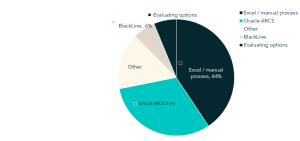
The respondents told us a lot about their current state. 44% are still using Excel or entirely manual processes. Another 6% rely on BlackLine, a specialist reconciliation platform, with 31% already on Oracle Accounts Reconciliation Cloud Service (ARCS). This distribution reflects the broader market reality: many organisations have accepted manual reconciliation as inevitable, unaware that better alternatives exist within their existing technology stack.
What reconciliation platform are you currently using?
The consequences of this ripple through the close cycle. Beyond the obvious time investment, organisations struggle with compliance and audit traceability (cited by 13% of respondents), inconsistent attribute assignment (3%), and delayed financial reporting and visibility (7%).
What’s causing the most problems in your close process?
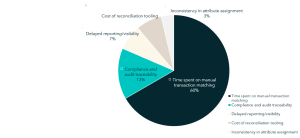
When you cannot automate the mechanical aspects of reconciliation, your finance team becomes trapped in a loop of exception management rather than analysis and strategic insight.
Oracle ARCS: Rebalancing the economics
Oracle ARCS represents a fundamental shift in how organisations approach accounts reconciliation. Embedded within the Oracle Enterprise Performance Management (EPM) platform, ARCS provides an integrated reconciliation engine designed for enterprises operating across multiple ledgers, subsidiaries, and compliance regimes.
Unlike point solutions that require separate licensing and data management, ARCS sits within your existing EPM environment, reducing implementation friction and operational overhead. The real opportunity lies in what ARCS enables: faster closes, improved control, and the ability to redirect reconciliation effort toward value-adding activities.
AI as the catalyst: matching, assignment, and conversational assistance
This is where AI reshapes the equation entirely.
Oracle ARCS now incorporates three AI capabilities that address the primary pain points revealed by our audience.
- The Transaction Matching Assistant uses a machine learning model trained on your historical manual match data to predict potential transaction matches for unmatched items targeting precisely the residual population that standard auto-match rules cannot resolve. Each prediction carries a confidence score, enabling reviewers to prioritise high-confidence matches for swift confirmation whilst applying appropriate scrutiny to lower-scoring suggestions. Critically, the model operates without pre-configured matching rules; it learns patterns from your historical data and evolves as users provide feedback
- The second capability, the Assignment Assistance feature, automates attribute prediction for reconciliation profiles. Rather than manually assigning preparers, reviewers, and risk ratings (a repetitive task that scales poorly as transactions volume grows) the AI model predicts these attributes based on account characteristics and historical precedent. Again, confidence scoring guides administrator decisions on which predictions to auto-apply versus review
- A third capability, Conversational AI, brings a Copilot-style natural language interface directly into ARCS. Rather than navigating menus, users can ask ARCS to show reconciliation status, view details and comments, run reports, or identify overdue items. Administrators can use the same interface to run Auto Match, train a match prediction, manage periods, and check job status. Where the two ML-based agents accelerate matching and assignment specifically, Conversational AI reduces the friction of everyday navigation and reporting across the whole reconciliation process
Together, these capabilities change the shape of the close. Manual transaction matching, which our poll respondents identified as the primary bottleneck, moves from a serial process into one where AI handles volume and complexity at speed, with human oversight concentrated on exceptions, while Conversational AI removes friction from the day-to-day navigation and reporting around it. This rebalancing accelerates close cycles and frees reconciliation teams for upstream data quality work and analytical review.
Why this matters for your organisation
The capabilities are available now. If your organisation currently holds an Oracle EPM Enterprise Cloud subscription, Transaction Matching Assistance, Assignment Assistance, and Conversational AI are seeded features within your licence. There is no additional cost to enable them. The barrier is not financial; it is organisational readiness.
Making the transition
The strategic question is not whether to adopt AI-powered reconciliation, but when. Organisations still operating in Excel face perpetual scaling constraints. Those on specialist platforms incur unnecessary licensing burden. Those with ARCS but without AI enablement are leaving material productivity on the table.

First

Second

Third
The transition from manual to AI-assisted reconciliation need not be disruptive. With structured enablement, it becomes a genuine productivity unlock – one your organisation may already have licensed but simply not yet activated.
If your close cycle is constrained by manual transaction matching, if you operate Oracle EPM but have not explored AI capabilities, or if you are considering alternatives to your current reconciliation platform, we encourage you to explore how ARCS can reshape your process.
We are ready to discuss a tailored proof-of-value session, customised to your specific account structure and close cycle dynamics.
The future of accounts reconciliation is here. The question is not whether your organisation will adopt it, but how quickly.
Watch the full Oracle ARCS webinar on-demand or contact us with any questions.