


































































Oracle Fusion AI embeds generative AI, machine learning and contextual tools directly into Fusion Cloud Applications. Rather than treating security as a post-implementation checklist, the platform relies on five fundamental architectural principles:
In my previous post, The Shift Toward Agentic Enterprise, I looked at how organisations can navigate the horizon of AI agents in Oracle Fusion by focusing on value, integration and measurable outcomes over pure volume.
But as we help teams across Europe map out their AI roadmaps, one question we are rightly and regularly asked by our own customers before any workflow gets redesigned is: “How do we make sure this respects our security, privacy and regulatory boundaries?”
Moving from experimental AI to full enterprise adoption requires absolute clarity on where data lives, how models process it and how compliance is maintained – especially within the evolving regulatory landscape.
The security architecture presented here is not an abstract concept – it is grounded in Oracle’s extensive technical documentation and formal security standards.
The following is a straightforward guide to the core security principles, data protection boundaries and sovereign controls built directly into Oracle Fusion AI.
Core security and privacy principles
Zero external data sharing
AI models (including Large Language Models) run entirely inside Oracle Cloud Infrastructure (OCI). No customer prompts or data are ever passed out to third-party or public AI providers.
Complete model and data isolation
Every organisation operates within a partitioned cloud environment. Your data, context and outputs are strictly isolated, ensuring no other organisation can ever access or view your information.
No training on customer data
Prompts and generated responses are not retained after processing. Crucially, your proprietary business data is never used to train shared or base models.
Context without retention
When AI retrieves internal documents to answer contextual questions (like HR policy queries), it reads the file strictly to answer that specific request. The document remains under your control and is not absorbed into the model.
Unified identity and access
Security configurations, user roles and access controls match your existing Fusion platform setups, ensuring consistent entitlement rules across all automated features.
Technical takeaways for organisations
For organisations navigating data sovereignty and governance, the core takeaways can be broken down into three main categories:
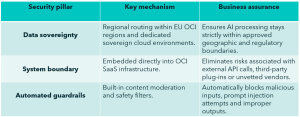

Local processing

Strict privacy

Controlled access

Standard alignment
Moving forward
Building an agentic enterprise isn’t about rushing to activate every available feature – it’s about deploying the right capability with total confidence in its security, alignment and underlying value.
Drawing from Oracle’s extensive technical documentation organisations can innovate with AI while remaining fully aligned with their data protection and compliance goals.
Looking to evaluate Oracle Fusion AI capabilities within your organisation’s compliance framework?
Our Oracle and AI teams work with enterprise organisations to plan, secure and roll out high-impact AI strategies grounded in robust security assessments. Get in touch with us to continue the conversation.
About the author
Ken MacMahon is a strategic enterprise applications leader and TOGAF-certified enterprise architect with extensive experience helping organisations modernise core Finance, HR, and business operations. Specialising in cloud transformation, managed services, and pragmatic AI integration, Ken focuses on aligning complex technology architectures with measurable business outcomes.