















































































The savings are largest for the smallest firms and shrink as headcount grows. Above roughly 1,000 employees, the saving settles at about $55,000 to $60,000 a year.
Three conditions come with the new prices.
Search Version 1

On 8th of October 2026, Oracle published a new Java Standard Edition (SE) Universal Subscription price list. For the first time since the employee-based metric arrived in 2023, organisations with fewer than 3,000 employees can get pricing built to match their size. A company with 100 employees that would have paid $18,000 a year under the March 2023 list now pays $1,000.
The old model charged $15 per employee per month for companies with 1 to 999 staff and $12 for those with 1,000 to 2,999. A ten-person firm paid the same per-head rate as a 900-person company which put undue pressure on the smaller company.
The new model replaces that with flat annual bands: $100 for up to 10 employees, $1,000 for up to 100, and $10,000 for up to 500.
Each employee from 501 to 2,999 then adds $147.20 per employee a year. Pricing for 3,000 employees and above stays as it was.
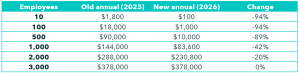
The savings are largest for the smallest firms and shrink as headcount grows. Above roughly 1,000 employees, the saving settles at about $55,000 to $60,000 a year.
Three conditions come with the new prices.
The bands cannot be stacked, so a company with 200 staff must buy the 500-employee band, not two 100-employee bands
The processor allowance now depends on headcount, from 1,000 processors at 10 employees to 50,000 above 500
If headcount exceeds the licensed number at any point during the term, the customer must buy more licences immediately rather than at renewal
Companies on the edge of a band need to watch their numbers closely. Moving from 100 to 101 employees raises the bill from $1,000 to $10,000.
Oracle has cut Oracle Java SE costs for organisations under 3,000 employees, with the largest reductions for firms under 100 staff. The savings come with three new constraints: non-stackable bands, headcount-linked processor limits, and an obligation to license mid-term growth.
What this means for customers
With over 200 years’ combined experience in Oracle licensing and in-depth knowledge of Oracle Java pricing changes, our team can help you navigate the changes and optimise your commercial outcome.
Our dedicated Java licensing website page hosts blogs, videos and links to further content, including our comprehensive overview of Oracle Java and its alternatives, Oracle Java discovery techniques and the steps involved if you wish to migrate to OpenJDK and an overview of Oracle Java audits and what this could mean for your business.
For help, contact the software asset management team.
Share this article