
















































































This is one of the defining questions for our industry. I expect providers to be paid to:
For years, the managed services industry has heralded automation.
We automated everything from tickets and deployments to monitoring, while introducing AIOps, copilots and smarter self-service. All those things have moved the industry forward, but AI is forcing a much bigger change.
The destination is not an AI-enabled managed service. It is an increasingly autonomous managed service and that distinction matters. AI now permits agents to do work that used to need a human expert, and that moves the question from ‘how do we make our people faster?’ to ‘which work should people still do?’
AI won’t simply become another capability bolted onto managed services. It will fundamentally change the operating model itself: what we manage, how we identify value, how we engineer improvements, and ultimately what you should expect us to be accountable for.
Three shifts sit at the centre of that change: AgentOps, forward deployed engineering and applications that increasingly manage themselves. First, though, it’s worth highlighting why the old model is running out of road.
Why the operating model must change now
The commercial model breaks first. Most managed services are still priced on effort: ticket volumes, resource days, rate cards. If a change that took ten days now takes two, a provider billing by effort earns a fifth of the revenue for the same outcome. Providers who price that way have every reason to slow AI down, and customers notice.
The analysts have noticed too. Gartner predicts in 2027, agentic AI will cut the cost-to-value gap in process-centric service contracts. Contracts priced on outcomes will undercut contracts priced on labour.
The pace of build has changed as well. Teams using agentic engineering can deliver a production-ready application in weeks. If every change after go-live then queues for a traditional support process, the customer feels the service slow down the day the application goes live. Support must run at the new speed of build.
Shift 1: AgentOps, operating the new digital workforce
As businesses adopt AI agents, who keeps them running, working correctly and delivering results?
This means tracking performance and drift, maintaining security and governance, continually improving agents and knowing when people step in.
In my view, AgentOps will extend managed services to run this digital workforce alongside applications, infrastructure and service processes. Agents will arrive from three places:
1. Agents that a provider builds
2. Agents that the customer builds
3. Agents that come with third-party platforms
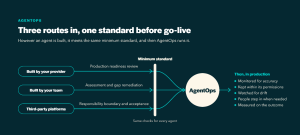
Each agent needs a route into production, and each should meet the same minimum standard before go-live:
- a clear purpose and owner
- defined identity and permissions
- evaluations and telemetry
- exception handling
- release and rollback
- a service level that is safe for an agent
Shift 2: forward deployed engineers who find the value in managed services
Operating AI is only half of the opportunity. The question I increasingly hear from customers isn’t “How do I get more AI?” it is, “Where should I apply AI next to create genuine value?”
I don’t believe the answer is another technology platform or a list of hundreds of potential AI use cases. The answer sits in the operation itself, and managed service providers are closer to it than anyone. We see the incidents, recurring problems, service demand, application behaviour, user experience and operational friction every day.
Managed Services forward deployed engineers work within your environments, alongside service teams and stakeholders. Using operational and experience data, they identify friction and AI opportunities, then engineer and deploy improvements, measure outcomes and learn from them.
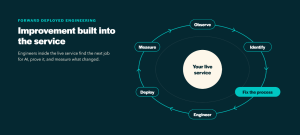
Two lessons stand out.
- First, fix the process before automating it: AI applied to a broken process only reaches the wrong answer faster
- Second, improvement becomes part of the managed service. FDE capacity belongs in the contract from day one, with an agreed improvement backlog, so customers stop buying agentic innovation as occasional projects
Because managed service FDEs sit close to the operation, they start with a problem and work out the best way to change the outcome.
Shift 3: applications that increasingly fix themselves
The third shift could be the most disruptive. AI-assisted engineering already changes how applications are designed and built. The next step connects those capabilities to application managed services.
Picture an application behaving abnormally. AI can analyse telemetry, logs, code and changes, diagnose defects and propose fixes. An engineering harness runs tests and security, quality and architecture checks before deployment; the service verifies resolution.
This moves us away from the traditional:
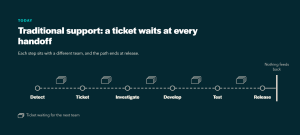
to this:
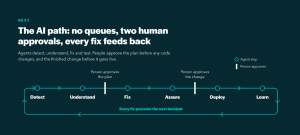
The harness used to build an application should support it just as efficiently. People approve changes before code is altered and again before completed work is filed. Agents never review their own work.
The goal isn’t just better application support with AI – it’s applications that increasingly spot problems, work out what’s wrong and fix themselves.
Autonomy is earned, one step at a time
Autonomous managed services will arrive process by process, at a pace set by evidence.
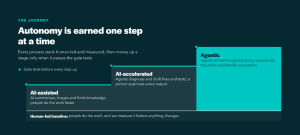
Every process starts human-led, and we measure it before anything changes. It then moves through three stages:
- AI-assisted: AI summarises cases, triages them and finds knowledge and similar incidents; people do the work faster.
- AI-accelerated: agents diagnose problems and draft fixes and tests; a person checks and approves every output.
- Agentic: agents act within agreed policy, such as deploying pre-approved low-risk changes once tests and rollback pass; people set the policy and handle exceptions.
A process moves up a stage only when it passes every gate:
- accuracy proven on real cases
- an audit trail in place
- a contract that permits the move
- service levels and liability agreed
- regulatory readiness confirmed
- rollback tested
- incident handling agreed
Not every process will move all the way to Agentic. Different organisations will stop at different stages, depending on risk appetite and regulation. The decision belongs to the customer, made on evidence.
Judge AI by what changed
It’s easy to count the number of agents created, copilots in use, processes automated and lines of code generated. But those metrics don’t tell us much about whether an organisation is actually better off.
The managed services commercial model needs to evolve alongside the technology, with Value Level Agreements sitting beside traditional service level agreements. That means measuring what you care about:
- time given back to employees
- avoidable demand
- better customer and employee experience
- faster delivery of change
- lower cost to serve
- Few incidents with more resolved autonomously
- fewer recurring defects
Time given back matters more than most people assume. HappySignals’ 2026 benchmark found that employees lose an average of 3 hours 18 minutes of productive time per IT incident. Every incident prevented gives that time back.
You will measure success differently. But the question is the same: what has the provider actually improved with AI?
People move from doing the work to governing it
People stay at the heart of managed services, but their role changes. Effort moves from repetitive operational activity to judgement, engineering, innovation and the complex problems where people add the most value. Engineers set policy, handle exceptions, own architecture and look after customer value.
That changes the economics of growth too. What will a managed service provider be paid to do?