3 min read
Understanding the managed services maturity curve

Organisations are increasingly turning to managed services to streamline their operations, optimise resources, and bolster competitiveness. However, the journey towards effective managed services is non- linear; it involves progressing through distinct stages of maturity.
The managed services maturity curve provides a framework for understanding where your organisation currently stands, what steps are required to move forward, and why this is critical for long-term success.
This post will explain what the managed services maturity curve is, the relevant stages, and why understanding your organisation’s position is vital for targeted improvements, informed investments, and long-term competitive advantage.
Let’s take a look.
What is the managed services maturity curve?
The managed services maturity curve is a conceptual model that charts the evolution of an organisation’s managed services capability. In reality, this curve is more like a squiggly line across the different services, however it always four key stages:
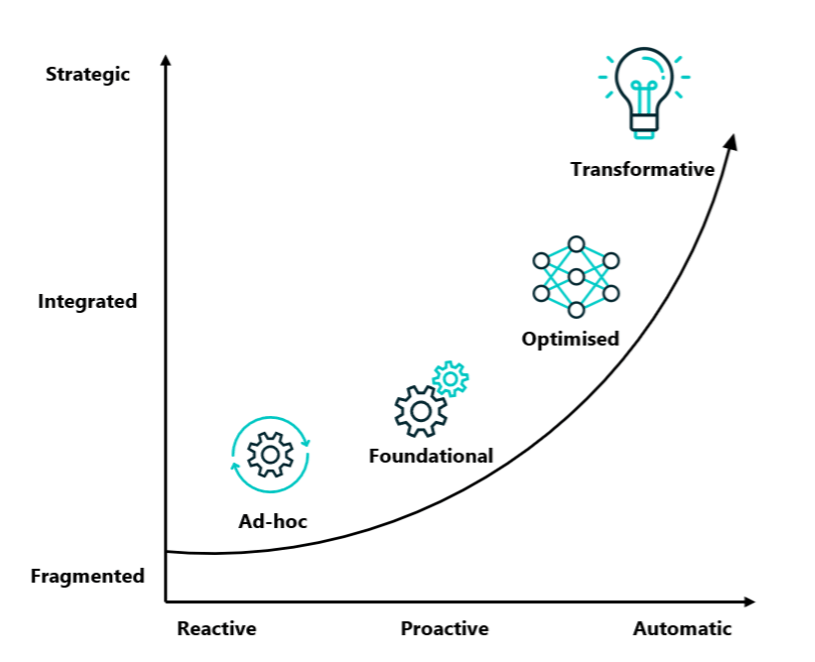

1. Ad-Hoc

2. Foundational

3. Optimised

4. Transformational
Why is it important to know where you are?
Knowing your organisation’s position on the managed services maturity curve is much like using a map when planning a journey. If you don’t know your starting point, it’s nearly impossible to chart an effective route or anticipate what resources you’ll need along the way.
Just as travellers risk getting lost or taking unnecessary detours without a clear sense of direction, organisations may waste time and investment, or miss critical growth opportunities, if they lack this self-awareness.
Knowing your position and direction of travel fosters a culture of transparency and shared purpose. Organisations that intentionally move up the curve experience:
- Faster Adaptation: Quicker response to market changes and threats
- Better Risk Management: Proactive security reduces major crises
- Strategic Focus: A pivot from managing infrastructure to innovating for the business
Progression along the maturity curve is not a one-off project but an ongoing commitment. It requires regular reassessment and adaptation to ensure that your managed services continue to deliver optimal value.
Why does this matter?
A study by IDC (2024) highlights how mature IT service management practices contribute to better risk management, faster adaptation to market changes, and more efficient allocation of internal resources.
This report also notes that organisations with advanced managed services often experience improved innovation and strategic focus, as operational burdens are reduced and teams can concentrate on value-adding activities.
A clear maturity roadmap provides stakeholders (be they internal teams, executive leadership, or external partners) with confidence in your organisation’s direction. It demonstrates a commitment to best practices and continuous improvement, which can be a decisive factor in client acquisition, retention, and overall reputation.
Ultimately, knowing where you stand and charting a path forward is not just about operational efficiency. It is about building a foundation for sustained growth, innovation, and competitive advantage. The managed services maturity curve is your compass – use it to navigate the complexities of modern IT.
In summary – how to get there
Every organisation’s managed services journey is unique, but the principles of maturity progression apply universally.
Consider these three actions;
- Assess your position and regularly review your managed services maturity
- Invest in the right improvements to advance your maturity, boost operational efficiency, and enhance strategic capabilities
- Commit to ongoing development by regularly assessing progress, implementing improvements, and embracing a culture of growth
By doing so, you not only optimise your current operations but also set your organisation on a path towards greater resilience, innovation, and success.
This directly aligns with our ASPIRE Managed Services by guiding continuous improvement, operational resilience, and strategic focus. ASPIRE delivers lasting value, fosters innovation, and positions your organisation to confidently meet evolving business demands and seize competitive advantage.
Contact us if you’d like to find out more.