




























































What determines whether organisations seize the AI-led transformation opportunity is almost entirely dependant upon their staff. Leaders know AI matters; but they regularly struggle to capitalise on people-led adoption. That is what we focus on.
A window of opportunity to realise ambitions
Few technologies have prompted the kind of inflection point that AI is generating right now. Across sectors, organisations are not just asking how to implement it, they are being even more reflective:
-
- Is our culture built for what this requires of us?
- Does our structure still reflect how work will get done?
- Do our people still understand the mission, and do they believe in it?
- Do our ways of working need to be redesigned entirely?
That is, in many ways, an unexpected gift. Disruptive as it feels from the inside, the arrival of AI at scale has opened a window for organisations to re-evaluate priorities.
“Increasingly, the speed of change is shaped less by tooling
and more by human readiness.”Cleo McCormack, Co-Creation Director, Version 1
The constraint has shifted
In the organisations we partner with, the appetite for innovation and AI solutions is considerable. What takes deliberate attention is ensuring the human and organisational conditions keep pace with the technical ones.
Forrester and Gartner both confirmed in 2025 that realising the full value of AI requires a systematic organisational response alongside the technical one. That is not a criticism of how organisations have operated to date. It is a recognition that the nature of what is being asked has genuinely shifted.
Traditionally, some organisations have struggled to instil the necessary change because implementing the tools took focus and the conditions for change did not receive enough attention. That is now evolving. Tools can be implemented much more rapidly —which affords time to ensure that structural organisational action is balanced with supporting individual readiness.
What shapes the quality of progress is human readiness: the capacity of people to move into new ways of working with confidence, to build skills without losing their sense of identity, and to trust that the organisation they work for is guiding them somewhere worth going.
A new perspective is needed
This is why the conversation about AI adoption needs to shift to people. Are the conditions right for people to genuinely adapt? Do managers understand their role as sense-makers, not just task-setters? Has the organisation aligned its ways of working with what it is now asking people to do?
Traditional approaches were designed for episodic, bounded disruption. What organisations face now is continuous, layered, and often personally confronting. Culture, structure, identity and purpose are all in motion at the same time. A framework built for a different era will not sustain.
REACH – change management framework: built for this moment
REACH was designed for exactly this. Built on the recognition that most AI and technology programmes overlook the human system, it reframes adoption as a trust, identity and capability challenge rather than a tooling or communication one. It was developed after observing recurring patterns: where current tools do not suit today’s scale or speed, and where the gap between what leadership intends and what people experience becomes the defining feature of the programme.
The change management framework operates across two connected layers.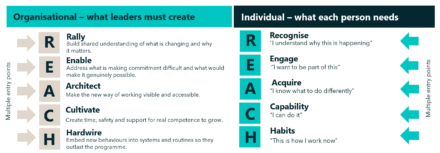
At the organisational level, REACH focuses on creating the conditions that make individual progress happen. This means connecting the work to mission and vision in ways that build real understanding, through role clarity. It means addressing what is making commitment difficult and what would make it genuinely possible: targeted skills development, training that connects to real work, and creating the time and space for people to build confidence before the pressure of go-live. It means redesigning policies, processes and ways of working so that new behaviours become possible rather than merely expected. And it means building the capacity to learn and adapt under pressure, so that progress outlasts the programme itself.
Hardwire is not a one-time event. REACH stays alongside until new habits actually form, measuring adoption, confidence and behaviour rather than activity completion. It does not move on when the project closes.
At the individual level, it maps five stages every person must genuinely move through: recognising why a shift matters, choosing to engage, acquiring the knowledge to act differently, building authentic capability, and forming habits that make new ways of working permanent. Skipping stages is not a shortcut. It is where adoption breaks down.
At the centre of both layers sit people managers. REACH treats them as the primary sense-makers: the people who translate organisational direction into lived daily reality. When that role is neglected, what leadership intends and what people experience are two different things.
REACH also holds a clear position on resistance. Rather than treating pushback as an obstacle, it recognises pushback as a signal. When people resist, they are nearly always identifying something real: a practical gap, a local constraint, an ethical concern, or an identity threat the programme has not yet addressed. Each deserves a response, not a workaround.
Where do you start?
Some organisations are rolling out AI tools and need shared understanding before anything else will land.
Others have completed training but are seeing low usage, which points to a capability or architecture gap rather than a communication one.
Others have hit a post go-live plateau, where early adopters are active but the rest are waiting for a permission that will not come unless the organisation actively embeds new ways of working into how it operates.
Some have inherited a stalled programme and need a diagnostic before deciding where to put energy next.
Each starting point maps to a specific entry in the change management framework. The entry point is determined by circumstances, not by where the project plan says you should be.
The organisations that navigate this period well will be those that used the disruption AI brought as a prompt to examine their culture, revisit their purpose, and rebuild trust with their people. Not as a defensive exercise, but as a genuine act of leadership.
REACH gives organisations a way to do that. Five elements. Two perspectives. One joined-up approach.
Talk to us about building human-centred change management that lasts.