



























































Foundation Risk Partners is one of the fastest growing insurance brokerages in the United States, with 26% annual growth. COO John Turner shares the five things that made the difference.
When we started Foundation Risk Partners in November 2017, we had a blank sheet of paper, a founding team with decades of experience across carriers and brokers of various sizes, and a conviction that the way most insurance brokerages were being built was fundamentally wrong.
The standard playbook in the US middle market is to acquire aggressively, bolt systems together, and hope the maths works out. You end up with a patchwork of legacy technology, siloed data, and an operational cost base that gets heavier with every deal you close. We decided early on that we were not going to do that, and that we would do all the heavy lifting up front because we believed it would give us a first-mover advantage that would compound over time.
Eight years later, we are one of the fastest growing insurance brokerages in the United States, with approximately 3,000 employees across 68 locations concentrated on both coasts. We serve the upper middle market across commercial lines, property and casualty, personal lines, employee benefits, and a growing financial services arm.
We have successfully integrated over 200 agencies into the platform, and we have been growing at approximately 26% annually through a combination of disciplined acquisition and strong organic growth, where every deal has to create immediate value rather than relying on financial engineering.
What I want to share here are the five things that made the biggest difference as we moved from building a data foundation to using AI to drive measurable financial results. Not what we think AI might deliver. What it is delivering today.
1. We built the data foundation before we knew what we would do with it
In the first five years of the business, we made a bet that most of our competitors were not making. While the rest of the industry was aggregating agencies, we were aggregating and normalising their data. We invested six years, from 2017 to 2023, in the painstaking process of standardising policy-level data across every agency we acquired, creating a clean, unified, and proprietary data asset that would become the essential fuel for everything we are doing with AI today.
The logic was simple, even if the execution was not. As an insurance broker, we receive information from every part of the value chain: customer data, carrier data, third-party data we acquire or purchase. We knew in 2017, before the current conversation around AI had even started, that if we could aggregate all of that into a clean, well-structured container, there would be something we could do with it later to solve problems and potentially monetise it. We did not know exactly what that would look like at the time, but we knew the foundation had to be right.
Our competitors face the opposite problem. The standard roll-up model typically creates a patchwork of disparate systems and data formats, preventing true synergy and scalable insights, with value left unrealised and trapped in disconnected silos. There are roughly 38 aggregators in the US market right now, all trying to do what we do, and each claims their own secret sauce. Ours was simply that we started from a blank sheet of paper and refused to accumulate technical debt from day one.
That data foundation now sits on Microsoft’s cloud and AI infrastructure. Our internal AI assistant, which we call AskFRP, is powered by Microsoft Copilot Studio and helps our people quickly find resources, information, and insights from across the organisation. It is the kind of tool that sounds straightforward but would have been impossible without the years of data standardisation work that came before it. The technology only works because the data underneath it is clean.
2. We built a revenue tool first and let the results do the convincing
When we moved into the second phase of our journey, the question was how to turn that data foundation into something that differentiates us in the market. This is the phase where we brought in Version 1 as a strategic partner to help us think through where the opportunities are to monetise what we had built.
On the revenue side, we built what we call a gap and wedge analysis tool as part of our OneFRP solution suite. In simple terms, it is a current-state analysis of what a client is doing across their insurance programme, with an AI-driven assessment of where they can improve: better lines of coverage, better terms and conditions, how they compare to competitors in their space, and how their programme integrates with things like lending agreements.

The impact on processing time alone has been substantial. A full gap analysis that used to take 40 hours can now be completed in around 4 hours, which is a 90% reduction. A wedge analysis that used to take 4 hours is now done in approximately 15 minutes, a 94% reduction. That time saving means our risk management service teams can focus on higher-value activities like training and client counsel rather than spending their days assembling reports manually.
The financial results speak for themselves. Revenue contribution is currently around $3.9 million and growing, with roughly $1.7 million flowing through to the bottom line, and that figure moves every day. The tool has already processed hundreds of submissions representing over $10 million in estimated revenue pipeline.
I will be honest: there was change management involved. Some of our most experienced salespeople questioned why they would need a tool like this when they have decades of experience and strong client relationships. That is a fair challenge, and the answer is not to tell them they are wrong but to let the results speak for themselves. The gap analysis tool has been proven to double close ratios for the teams using it consistently. Building the revenue tool first, rather than starting with cost reduction, gave us a proof point that made everything that followed easier to fund and easier to get buy-in for across the business.
3. We are significantly reducing BPO work, not offshoring it
On the operational side, we have taken a fundamentally different approach to the industry norm. The standard play for many insurance brokers has been to move low-value, high-volume transactional work to external delivery models in lower-cost locations. But that approach does not always create meaningful productivity gains. In many cases, it is a cost-based solution that delivers only temporary benefit before the economics begin to shift again.
We took a similar approach ourselves, and we still have BPO arrangements in place today. But our goal is to significantly reduce our reliance on them by 2027. We believe the tools we are deploying and building with Version 1 can remove much of that work altogether, creating greater long-term value than simply relocating it to a lower-cost model.
One example that illustrates the point well is policy checking. This is a task many brokers either do not do as consistently as they should, because it is the last thing an account manager wants to spend time on, or assign to external teams as a lower-cost processing activity. But getting it right matters enormously. From an errors and omissions perspective, we are financially exposed if policies are incorrect. And beyond the legal risk, the policy is the end product of everything we do as a brokerage. We sell an intangible product: a concept of financial security and business protection. The policy document is the deliverable, and not ensuring it is a quality product has always struck me as unacceptable. Automating policy checking has removed approximately $2.5 million of outsourcing fees from the system while simultaneously improving accuracy and quality.
We are also deploying tools for standardised proposal generation, automated policy and cost comparisons, automated certificates of insurance, renewal cycle automation, and claims management and analytics using agentic tools. In total, the OneFRP platform now includes a suite of sub-agents covering areas from producer toolbox access to loss control to HR resources, alongside functional tools for benchmarking, loss run analysis, deductible modelling, and automated statement of value generation. Most of these are already live. The breadth of what a seven-person team can deliver when the data foundation and the right partner are in place is considerable.
4. Every use case goes through a build, buy, or partner filter
We follow a disciplined framework for evaluating every AI use case, and Version 1 helps us run each one through it. If building a tool gives us a distinct competitive advantage, something market-leading that we want to control from a positioning perspective, we build it. If there is an existing tool we can deploy quickly and gain immediate productivity or financial benefit from, we buy it. And sometimes there is a middle ground where a deeper strategic relationship with a product provider, a joint venture or a co-development arrangement, gives us more advantage than a straightforward vendor purchase.

Our AI development follows a rigorous, structured five-step gated process, from initial assessment and prioritisation through to testing and evolution, ensuring every initiative is aligned with strategic priorities and demonstrates clear ROI before it moves to the next stage. We prioritise based on business value and complexity, tackling the high-impact strategic initiatives and quick wins first to build momentum and prove the model before scaling.
I should say something about how we choose partners, because it matters for anyone thinking about doing this themselves. We make it very difficult for anyone to sell to us. Our approach is that if we are going to work with you, you will be a partner, not a vendor, particularly in something this important and transformational. The barrier to entry is high, but once you are in, we go hard together. Version 1 cleared that bar, and the relationship has been central to what we have been able to achieve. Having a partner that brings deep AI and data expertise, combined with a structured methodology for evaluating and delivering use cases, means we do not need to build a large internal team to get results.
5. You can do this with seven people if you get three things right
We have achieved everything I have described above with roughly seven people dedicated to the work. For a business of our size, that is a very lean team, and people are often surprised when I tell them. I believe there are three reasons it works.
First, we have a small group of people who are genuinely excited about solving problems, not about AI for its own sake but about finding the places where technology can make a measurable difference to how we serve clients and how we run the business. Second, we have a strategic partner in Version 1 that extends our capacity and brings specialist capability without us needing to hire a large internal team. Third, we have had a board that has given us enough latitude to experiment and invest in the right places. Some of this work is costly to execute, or even to learn from when things do not go as planned, and having the backing and a clear understanding of the economic value these investments can deliver has been critical.
Those three things together, a focused internal team, a genuine strategic partner, and a supportive board that understands the investment, allow us to do significantly more with less than our competitors. And I think that combination is replicable for other mid-market brokers who are willing to take the same approach.
What it all adds up to
Everything I have described above adds up to 300 bps of EBITDA uplift. That breaks down into approximately $2 million from business process transformation, scaling tools like automated policy checking across all of our locations to drive enterprise-wide efficiency, and approximately $8 million from business performance transformation, leveraging data for improved lead conversion, systematic cross-selling, and targeted upselling across our client base. That is not a projection or a near-term aspiration. That is the opportunity we are executing against right now.
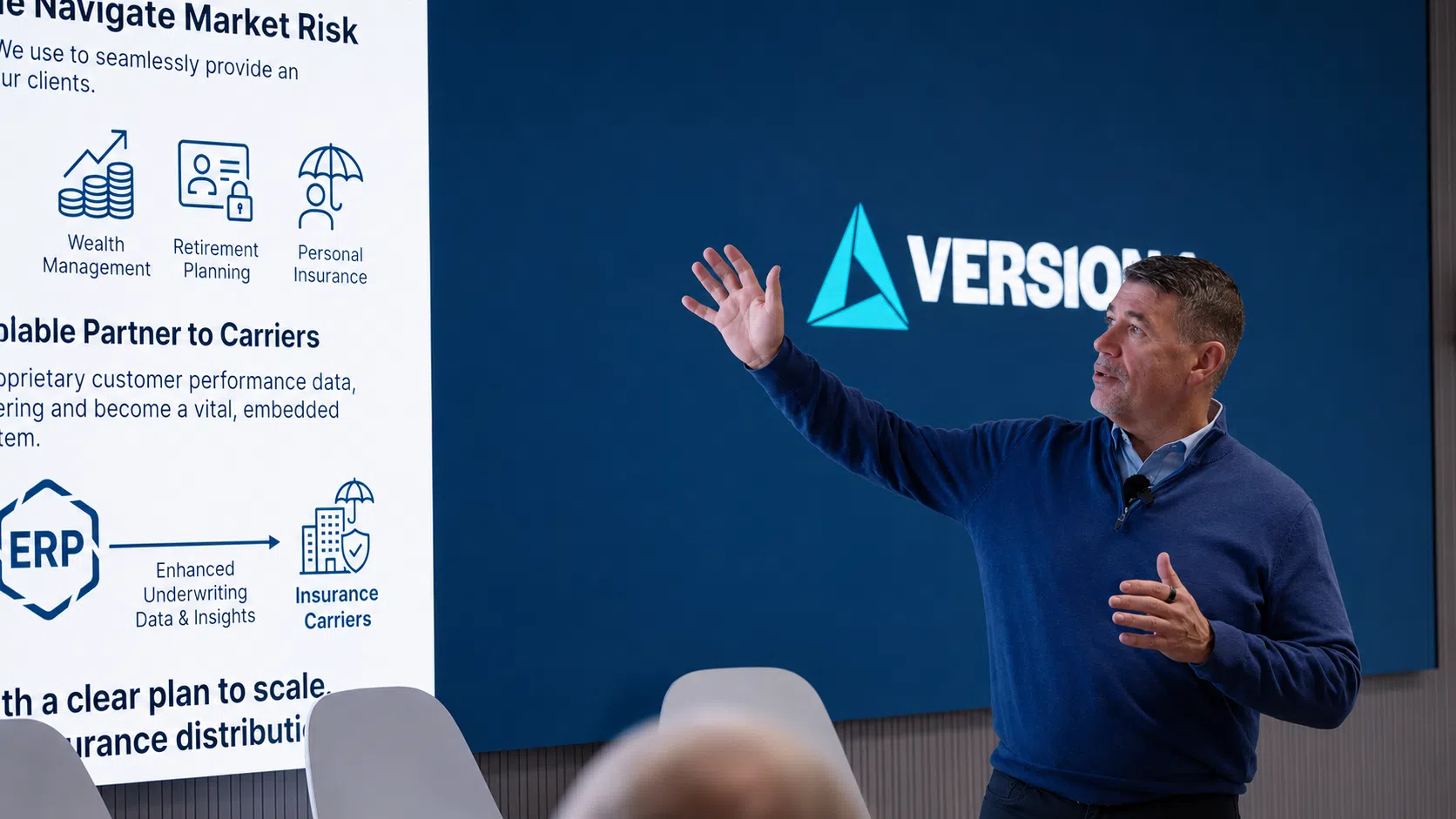
From a broader transformation perspective, we think about where we sit in the value chain and how we can create value in both directions. As a broker, we sit between multiple stakeholders: the financial buyer, the HR suite, employees, and in the US context, their dependents. On the other side, we work with carriers and strategic product partners. Our goal is to become the single source for middle market risk, seamlessly providing an integrated suite of risk solutions across property and casualty, employee health, life insurance, wealth management, retirement planning, and personal insurance. By automatically transmitting proprietary customer performance data, we can enhance carrier underwriting and become an indispensable, embedded partner in the insurance ecosystem.
Our ultimate goal is that regardless of where our people are located, whether in Los Angeles, New York, Miami, Chicago, or a smaller town, we have the ability to compete against any competitor, on any risk, and win. We are a relationship business and a people business, and our biggest expense line is people. AI does not replace that. It is a force multiplier that makes our people better at what they do.
If we get both of those elements right, the people and the technology, we will have built something that lasts. And what I want to leave for the next generation of people in this business is the opportunity to take it forward and continue to grow it.
John Turner is Chief Operating Officer at Foundation Risk Partners and spoke at Version 1’s Insurance Leaders’ Forum in March 2026.