





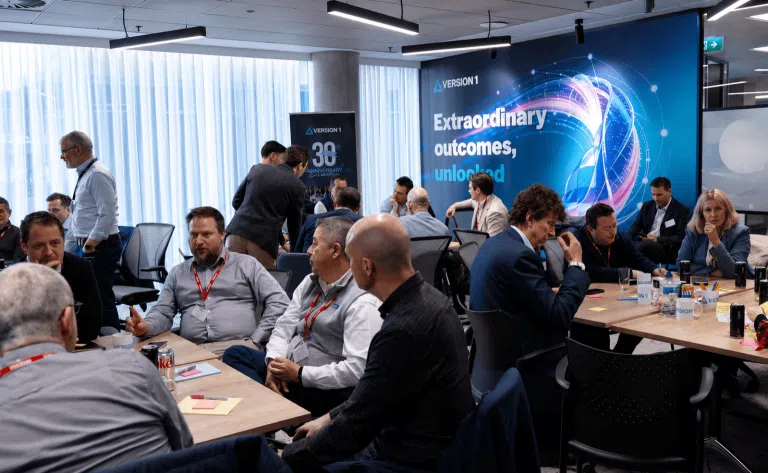























































The financial services industry is abundant in many ways. It has the models, the infrastructure, and in many cases the data to engineer the future. What it lacks is the organisational will and cultural clarity to move from experimentation into genuine transformation. That is the uncomfortable truth that surfaced at our recent Women in Tech Leadership event in New York, where a panel of three senior leaders from across the financial services ecosystem spoke with a frankness that is rare in industry forums. The conclusion was unambiguous: this is not a technology problem, it’s a leadership one.
The misconception that is costing us most
When asked to name the single biggest misconception about AI in financial services, the answer from one panellist was direct: AI is not primarily about reducing costs. The framing of AI as an efficiency tool, a faster way to do the same things we have always done, is exactly the kind of thinking that leaves value on the table. The opportunity is not to automate the status quo, it’s to discover what was previously unachievable and then grow it at scale.
This is worth considering carefully, because the majority of AI business cases presented across the industry today are built on cost reduction. They are justifiable, measurable, and will certainly deliver returns. But if that is the ceiling of ambition, then the ceiling is too low. The institutions that will define the next decade of financial services are not the ones that cut 10,000+ hours of variance analysis. They are the ones that reimagine what their business can do when those 10,000+ hours are redirected.
“Stop measuring AI success by how many use cases you have in production. Start measuring what those use cases are actually generating.”
That said, and this was a theme the panel returned to repeatedly, the less visible wins matter. One panellist, speaking from an infrastructure perspective, was clear: the middle and back-office automation stories are where some of the strongest, most demonstrable ROI is hiding right now:
- Document processing reconciliation
- Variance analysis
- Developer productivity
These are not the headline use cases, but they are the ones that can be tested, verified, and discussed with confidence.
Her point about Amazon’s developer productivity gains is a number that should land differently for every CIO in financial services trying to justify an AI platform investment: moving from one deliverable feature per sprint to four, across an engineering population of tens of thousands. That is the kind of compounding return that back-office AI investment can generate when applied at scale.
Culture, not data, is the real blocker
When the conversation turned to where AI adoption most commonly stalls, the panel converged quickly: culture, not technology. One speaker, who works across sixty of the world’s largest financial services institutions, made the point that two banks can begin identical AI projects on the same day, with comparable data estates and comparable infrastructure, and six months later one will be in production while the other is still navigating internal compliance queues. The technology was never the differentiator. The organisational culture was.
This does not mean data quality is irrelevant. Another panellist, responsible for the data and records risk posture of a major global bank, was direct: feeding poor data into an AI model does not produce better outputs. It produces worse ones, faster. The fundamentals of data management, clear ownership, known lineage, defined quality controls, are not obstacles to AI deployment. They are prerequisites for it. The misconception is assuming that AI will resolve data quality problems rather than expose and amplify them.
The more stubborn constraint, however, is still cultural. In highly regulated environments, risk aversion can become an identity rather than a discipline. The question the panel posed is one worth taking back to your own organisation: has the pendulum in your institution swung so far toward caution that the culture itself has become the blocker? There is a version of risk management that enables innovation within guardrails. There is another version that simply prevents it. The best leaders in this space know the difference and actively manage which version they are operating.
Stop treating governance as an afterthought
Perhaps the sharpest practical insight of the evening came on the subject of governance. The argument from one panellist was not that governance should be lighter. It was that applying a single, undifferentiated governance model uniformly to all AI use cases is itself a failure mode. Her framework was pragmatic: tier your use cases by the nature and consequence of the decision being made.
If you have high confidence in your data and the use case does not feed a regulatory submission or a major executive decision, move faster. If it does, apply proportionate rigour. The error most institutions make is applying maximum governance to everything. The result is that maximum governance effectively governs nothing. It simply delays everything equally.
A second panellist built on this with a point that deserves wider circulation: bring governance and compliance into the room from day one, not as a checkpoint at the end, but as co-designers of the solution. Define the guardrails at the outset, establish what is permissible and what is not before development begins, not after a pilot is ready to scale. When you do that, the governance function shifts from being an obstacle to being an accelerant, because every decision after that point is made within a framework everyone has already agreed on.
“Governance, done right, gives you the confidence to scale. It is not the brake. It is the guardrail that lets you go faster.”
Metrics that are actually meaningful
The question of how to measure AI productivity over the next twelve months produced a framework that cuts against the instinct of most programme governance teams. Three proposed measures stood out.
First, are the tools actually being used? Adoption is a leading indicator; productivity is a lagging one. Second, cycle time metrics tracked over three to twelve months, where the signal emerges slowly but clearly. Third, exception rates for agentic systems, which should decrease over time as models improve.
That third metric warrants particular attention for organisations deploying AI into middle and back-office processes. If you are not tracking exception rates, the frequency with which a human needs to intervene in an AI-driven workflow, you are missing one of the clearest signals of whether your system is genuinely learning or simply running on static logic at greater expense. This is distinct from conventional automation monitoring and requires deliberate instrumentation from the outset.
What FSI tech leaders should stop, start and scale in the next 12 months
The panel ended with a direct challenge to every financial institution in the room. Despite coming from three individuals with different vantage points, the answers converged on the same underlying logic.
STOP Measuring success by the number of use cases in production. That metric is a proxy for activity, not value. Stop applying the same governance model to every AI initiative regardless of risk profile
START Enabling your developer community with AI tooling. Not because it is fashionable, but because it is the highest-ROI investment available in a regulated environment where code underpins every client-facing capability. Start embedding compliance thinking into the design process rather than adding it at the end
SCALE The unglamorous automation: back office, reconciliation, document processing. These are the wins that compound. They are also the ones you can measure, verify, and take to a board
What this means in practice
What made this panel different from many industry conversations about AI was the absence of hedging. These were leaders who have navigated internal politics, dealt with adoption curves, and sat in front of boards demanding ROI without increased residual risk. They were willing to say plainly what works and what does not.
The message is this: the technology is ready. The models are there. The infrastructure question is largely resolved for institutions that have made the cloud commitment. What remains is a set of organisational and cultural decisions that only leadership can make.
Who owns AI deployment? What constitutes acceptable risk at each tier of use case? How do we measure genuine value rather than programme activity? How do we bring our people on a journey rather than imposing change on them?
These are not questions with vendor answers. They are leadership questions. The institutions that answer them with clarity and conviction, rather than waiting to see what everyone else does, are the ones that will move from incremental change to genuine transformation.
For more detail on our financial services expertise in EMEA and the US, visit our Financial Services page or get in touch here.
Nick McFadden is Regional Director – North America at Version 1. Version 1 partners with financial services organisations across the UK, Ireland and North America on cloud, data, and AI transformation. To continue the conversation, contact us below.