

































































90
%
Gap analysis cycle time reduction
Search Version 1


Foundation Risk Partners (FRP) is one of the fastest growing insurance brokerages in the United States, with approximately 3,000 employees across 68 locations and 26% annual growth. Founded in 2017, FRP has successfully integrated over 200 agencies into a national platform serving the US upper middle market across commercial lines, property and casualty, personal lines, employee benefits, and financial services.

Gap analysis cycle time reduction
Wedge analysis cycle time reduction
New revenue generated
EBITDA from AI tools
Operational expense avoidance
Concept to production
Close ratio improvement
EBITDA uplift
The standard playbook for insurance roll-ups in the United States has been to acquire aggressively, bolt systems together, and deal with the data problem later. FRP’s founding team took a fundamentally different approach. Between 2017 and 2023, while the rest of the market was focused solely on aggregating agencies, FRP invested six years in standardising and normalising policy-level data across every acquisition, building what they describe as a clean, unified, and proprietary data asset. That decision, made before AI was even part of the conversation, created a defensible competitive moat that would become the foundation for their entire AI transformation.
By 2023, with the data foundation in place, FRP faced a question that many insurance leaders are now grappling with: how to turn a clean data asset into measurable business value at scale. They needed a partner who could help them identify the highest-value AI use cases, build production-grade tools, and move fast enough to maintain their competitive advantage in a market where the technology changes every few weeks.
Choosing a strategic partner
FRP engaged Version 1 as a strategic partner to identify, evaluate, and deliver AI use cases across the business. For any insurance organisation considering how to choose an AI partner, FRP’s approach offers a clear lesson: they deliberately structured the relationship as a partnership rather than a vendor arrangement, with Version 1 embedded as an extension of FRP’s lean internal team.
Version 1’s role extends well beyond AI development. Richard Dinan described the breadth of the relationship: Version 1 brings thought leadership around well-architected frameworks with Microsoft, governance, managed services, and expertise across the Azure environment and the Microsoft product stack. FRP can come to Version 1 for any enquiry in the Microsoft ecosystem, allowing FRP’s internal team to focus on the business rather than the tools.
“We look at Version 1 more as a partner in this process versus a vendor of solutions. The partnership has gone extremely well. We’ve been able to create a lot of value for both parties.”
John Turner, COO, Foundation Risk Partners
FRP is a Microsoft-first organisation, and for insurance leaders evaluating which technology stack to build their AI strategy on, FRP’s experience illustrates why staying native within a single ecosystem can accelerate transformation. From the earliest stages of building their technology foundations, before AI was even on the agenda, FRP made a strategic decision to invest in the Microsoft stack and stay within that environment for both economic and security reasons.
“Even before we thought about building AI tools, when we were building the technology foundations we would need to scale the business, we took the approach that we were strategically going to invest in the Microsoft stack of tools and really stay in its native environment. Our preference would be to stay native with Microsoft because one, it’s better leverage for us from an economic standpoint, and two, from just a security envelope and the way we structured data, it made more sense to stay as native as possible.”
John Turner, COO, Foundation Risk Partners
That Microsoft-first approach has carried through into FRP’s AI deployment. Their internal AI assistant, AskFRP, is powered by Microsoft Copilot Studio and serves as a centralised hub for producers, agents, and staff to access information, resources, and AI-driven insights from across the organisation.
“As far as the Microsoft technology stack, Foundation Risk Partners is a Microsoft-first shop. When we went down this path of enabling some of our AI capabilities, it was a natural fit to continue to leverage as much of the product suite within Microsoft, because then you’re not having to recreate the wheel regarding security, permissions, access. Everything is ring-fenced in the tenant.”
Hyong Jin Park, EVP Application Development, Foundation Risk Partners
The first major use case FRP and Version 1 tackled together was on the revenue side, addressing a question that sits at the top of every insurance leader’s agenda: how to use AI to drive sales growth and improve conversion rates without sacrificing the quality of advice that clients expect.
Version 1’s AI Labs analyzed FRP’s manual gap and wedge analysis process and developed an AI solution to automate it as part of FRP’s One FRP solution suite. The tool reviews and assesses large volumes of policy documents against business rules specified by FRP, identifies coverage gaps and improvement opportunities, and generates content for producers to use in client and prospect conversations. Critically, the solution retains a human validation step: AI identifies the issues, a human expert confirms the findings, and the end product is passed to the producer.
The impact on processing time has been substantial. A full gap analysis that previously took 40 hours can now be completed in approximately 4 hours, a 90% reduction in cycle time. A wedge analysis that took 4 hours is now completed in around 15 minutes, a 94% reduction. That time saving means risk management service teams can focus on higher-value activities like training and client counsel rather than spending their days assembling reports manually.
Since launch in July 2024, the tool has generated approximately $2.6 million in new revenue, with roughly $1 million in positive EBITDA contribution. It has processed hundreds of submissions representing over $10 million in estimated pipeline revenue and has been proven to double close ratios for the teams using it consistently.
On the operational side, FRP and Version 1 are deploying a suite of tools designed to reduce transactional work wherever possible rather than simply offshoring the work. For insurance organisations still relying on BPO arrangements as their primary approach to managing low-value work, FRP’s approach demonstrates a fundamentally different path: automate the work with the power of our AI-enabled tools and capture the full financial benefit rather than just the labour arbitrage.
FRP had already committed to automating transactional work as much as possible. Their automated policy checking has been a significant early win, removing approximately $2.5 million of outsourcing fees from the system while simultaneously improving accuracy. FRP is also deploying standardised proposal generation, automated policy and cost comparisons, automated certificates of insurance, renewal cycle automation, and AI-driven claims management and analytics.
The OneFRP platform now encompasses a broad suite of sub-agents and functional tools designed to empower the user. Resources are now optimized for AI for swift and accurate retrieval including client-facing deliverables for loss control, benchmarking, loss run analysis, deductible modelling, and automated statement of value generation. Most of these are already live in production, demonstrating the scale of what a small, focused team can achieve with the right partner and the right data foundation beneath it.
Managing AI governance in a regulated insurance environment is one of the most significant barriers to scaling AI deployment. FRP operates under 50 US state regulators, federal requirements, and international insurance treaty obligations, which means that every AI application has to comply with a patchwork of emerging regulatory frameworks.
Version 1 brought its own partnership with Credo AI into the relationship, providing FRP with an enterprise-grade framework for managing AI regulatory compliance without the need to build a large internal compliance team from scratch. FRP’s AI development follows a rigorous five-step gated process from assessment and prioritisation through to testing and production deployment. A cross-functional steering committee representing IT, compliance, and business leadership oversees every application, ensuring that no single function makes decisions that could impact the organisation’s ability to operate.
The combined impact of FRP’s AI programme represents more than 300 bps of EBITDA uplift, comprising approximately $2 million from business process transformation (scaling tools like automated policy checking across all locations to drive enterprise-wide efficiency) and approximately $8 million from business performance transformation (leveraging data for improved lead conversion, systematic cross-selling, and targeted upselling across the client base).
All of this has been delivered by a small, internal team, augmented by Version 1 as a strategic delivery partner and built on the Microsoft technology stack. FRP went from concept to production on their first AI use case in 14 weeks.
Every tool FRP builds is designed as a reusable capability rather than a single-purpose solution, so that capabilities can be scaled and applied to new use cases as they emerge across the business. That approach to building reusable AI capabilities, rather than point solutions, is one of the reasons a seven-person team has been able to deliver results that larger organisations with far bigger budgets have struggled to match.

Over the next 12 months, FRP’s focus is on further reducing friction costs across non-value-adding activities, freeing team members to spend more time improving client relationships and delivering higher-value counsel. The vision, as Richard Dinan describes it, is the removal of clicking through multiple systems to get things done.
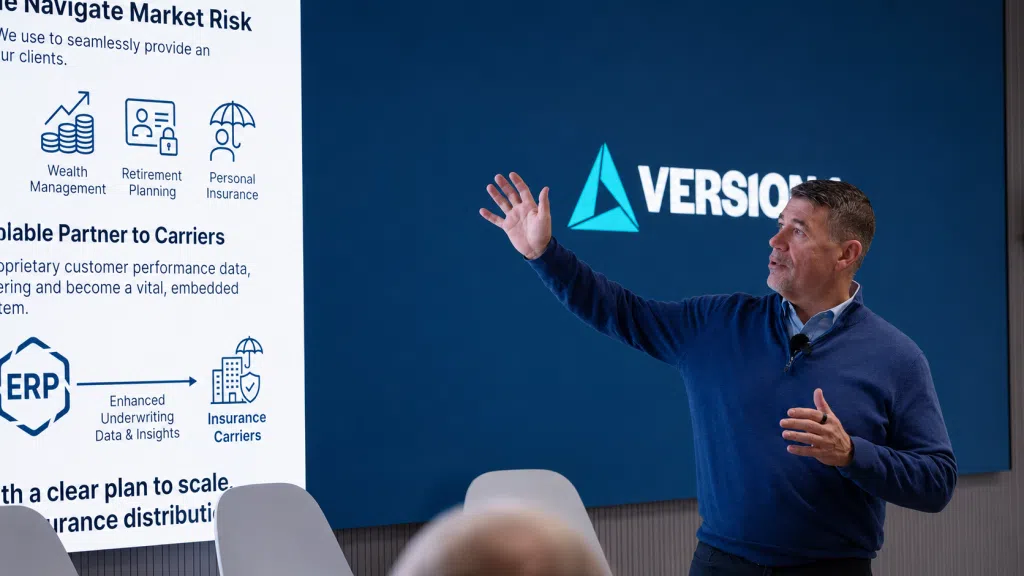
From a broader strategic perspective, FRP is building towards becoming the single source for middle market risk in the United States, seamlessly providing an integrated suite of solutions across property and casualty, employee health, life insurance, wealth management, retirement planning, and personal insurance. By transmitting performance data to carrier partners, FRP aims to enhance carrier underwriting and become an indispensable, embedded partner in the insurance ecosystem.

